There is a place in America for diversity of views and opinions. I may cook my gumbo differently from you, but that does not make mine better. I may just use different ingredients. Politics has gotten so spicy, and we need to cool it down some. We may find that your recipe for gumbo is just as good.
Donna Brazile

Talk about being nervous!
Like the rest of the country, I have had a number of sleepless nights and been feeling intensely anxious in the run up to and aftermath of Tuesday’s presidential election. I learned the good news yesterday via texts from friends and a phone call with my son Emmet, who was able to share the screams of elation coming from his Brooklyn neighbors.
To assure myself the news was true, I tuned my TV to the conservative Fox News network. Sure enough, they were also calling the election for now President-Elect Biden and downplaying the merits of litigation challenging the results. It was a fortunate decision on my part because I watched, in real-time, a heartfelt expression of gratitude for the election of Vice-President-Elect Kamala Harris by Fox contributor and former Democratic National Committee head Donna Brazile.
Brazile, a black woman from New Orleans, said she was going to celebrate the Biden-Harris victory by making a gumbo. I took this as a sign that I should do the same!
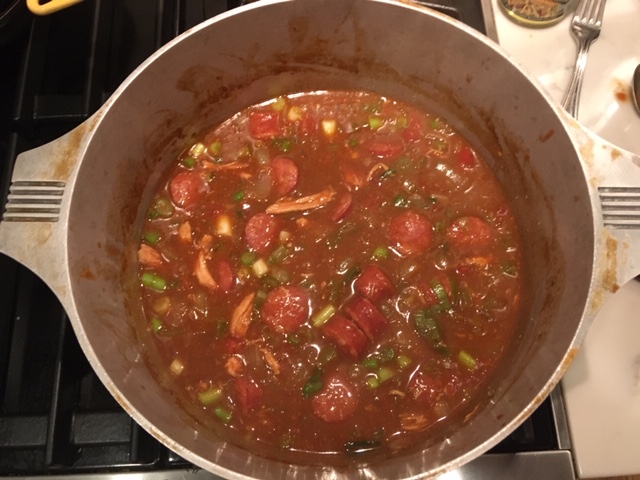
Gumbo sits atop my food pantheon, resting comfortably at the right hand of red beans and rice. I have so much to say about gumbo so this will not be the last word from me on the subject. In fact, I continue to fantasize about writing a book exploring the meaning of gumbo, including all the metaphorical and tangible ramifications of gumbo as they relate to politics, race relations, culture and even religion.
Over the past four years, and particularly in 2020, I have come to believe that the ghosts of America’s racist past continue to haunt our present and, as Joe Biden has so eloquently said, corrupt the soul of our nation. Gumbo, the official food of both Creoles and Cajuns, connects those who enjoy the dish today with the deep African and Caribbean roots of American cuisine. So celebrating what we can only hope is the beginning of the end of Trumpism (i.e. the last gasp of the 20th Century Majority) with a bowl of spicy gumbo seemed more than fitting.
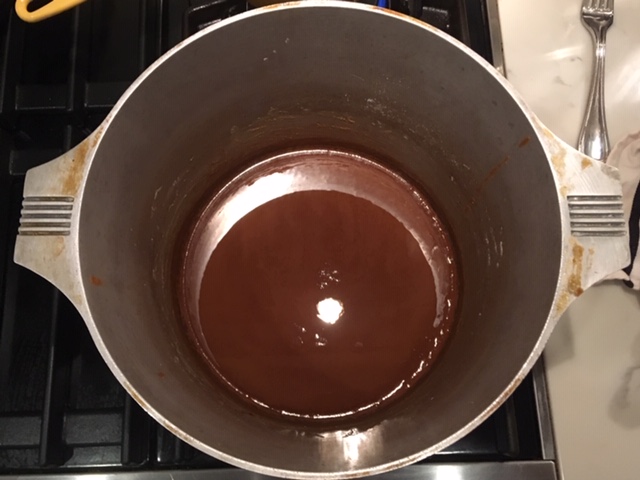
Frankly, there are probably hundreds of ways to make gumbo. The first gumbo I made, in 1992, a chicken and sausage gumbo, was based on a handwritten recipe supplied by a New Orleans native who had grown up in the Irish Channel, the mother of a friend of mine. I also closely studied the recipe for “Chicken and Andouille Smoked Sausage Gumbo” and the pictorial descriptions of how to make a roux in the late Paul Prudhomme’s “Louisiana Kitchen,” which remains a towering classic of Louisiana cuisine. Sadly, Prudhomme’s flagship restaurant K-Paul’s did not survive the pandemic of 2020.
In more recent years, the national food media has rightly appointed the late Leah Chase of the famous Treme eatery Dooky Chase as the grand empress of gumbo. Versions of her gumbo recipes about on the Internet Here‘s a good one. You can even find the newest generation of foodies at Bon Appetit trying to recreate her recipe from a blind taste test. I tried her gumbo once; it was magnificent!
In his Time Magazine remembrance, fellow New Orleanian Walter Isaacson quotes Chase, who was renowned for feeding the giants of the Civil Rights Movement, as saying: “Food builds bridges.”
My appreciation for gumbo long predates these early efforts to make my own. My best food memories take me back to early childhood and meals at the Log House restaurant on the Biloxi-side of Debuys Road, where they served a classic Gulf Coast seafood gumbo and these really tasty, almost tangy biscuits. That combination might well be my pre-electric-chair meal. The Log House is long gone, but I look forward to sampling that same style of gumbo whenever I go home, whether at Mary Mahoney’s or the Beau Rivage Buffet or even the hot bar (if it still exists) at Rouse’s grocery store outlets along the Gulf Coast.
My own approach to gumbo continues to evolve as the years go by; sometimes I use tomato product or okra or file or shrimp. Other times it’s just a straightforward dark brown roux with the trinity (onions, peppers, celery) and maybe some garlic, along with chicken and sausage and some Creole seasoning and hot sauce. I have also dabbled with seafood gumbo and gumbo z’herbes (a meatless gumbo made with greens). I serve gumbo over rice. I have tried serving it Cajun-style with potato salad. It’s an interesting flavor combination, but violates the comfort food expectations I have for gumbo.
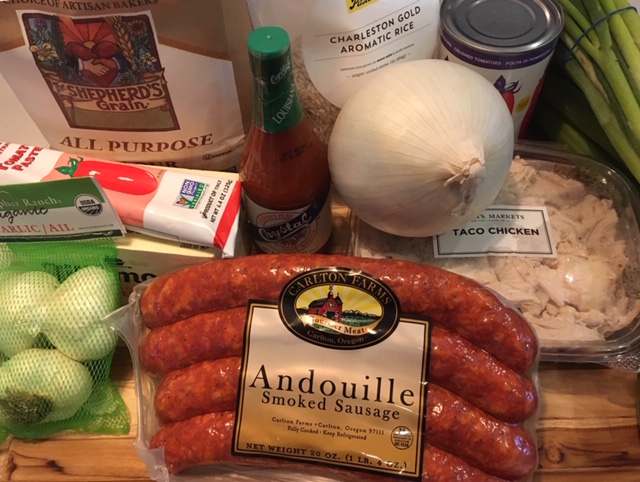
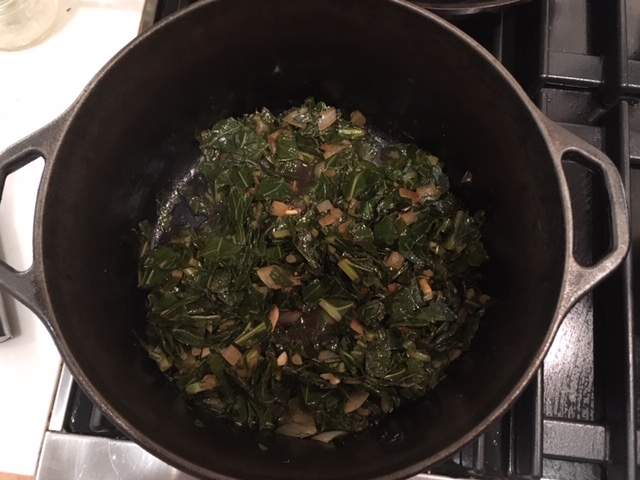
For yesterday’s celebratory gumbo, I used a can of crushed Italian tomatoes, added garlic, pre-cooked chicken and some good, locally made Andouille sausage, but no okra or file. I don’t really have a recipe. I just wing it. The two recipe links I posted above represent good starting places. The beauty of gumbo is that once you have the basics down, you can improvise. In making my celebratory gumbo, which turned out beautifully, I focused on making the best roux I could produce in my 30-plus-year-old Maganalite pot, a favorite of Cajun cooks. I also braised collard greens in a black iron dutch oven, and roasted and buttered a sweet potato, all accented by a bottle of sparkling apple cider.
As for our country, here’s hoping that we can find a creative, improvisational way forward, despite our deep differences. I believe we can do it, but only if we are honest about who we have been and how that has affected who we are today. Like making a good gumbo, we have to go back to the basics, to the ideals of real equality expressed in our principal charter. Reconciliation must be predicated upon truth in the same way that you can’t make a good gumbo if you burn the roux.
Appropriately, this week’s $25 donation goes to the Emeril Lagasse Foundation. Thank you for spending a little time with me.
 The Nervous Southerner