Before there was Julia Child, there was Craig Claiborne, who looms large in the culinary consciousness of Americans. A native son of the Mississippi Delta, Claiborne learned the love of food in the kitchen of his mother’s boarding house and followed that passion to become a world-traveling gourmand who headed up the New York Times food section for decades and authored the influential “New York Times Cookbook,” published in 1961, among more than two dozen books about cooking and dining.
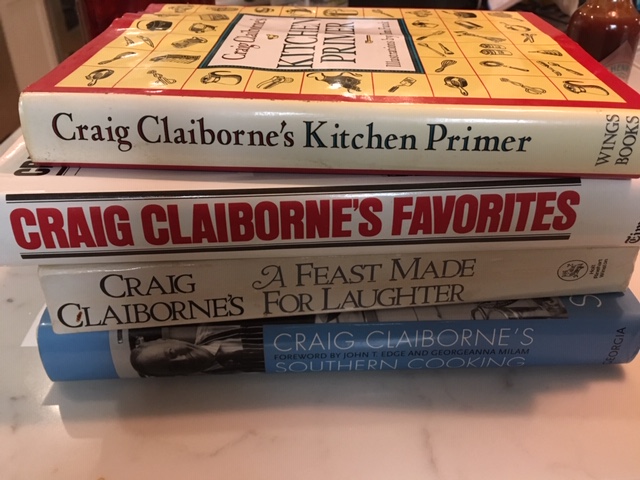
two dozen books
Claiborne famously won his New York Times post by bonding with then-managing editor Turner Catledge over their Mississippi roots, and fellow food critic James Villas has been quoted as saying: “There has never been any question in my mind (that it) was Craig Claiborne, not James Beard or Julia Child, who first introduced Americans to the glories of great cooking and fine dining.”
If you want to dig into the discussion of Claiborne’s legacy, I recommend John T. Edge’s loving appreciation in the forward to the 2007 University of Georgia re-release of Claiborne’s “Southern Cooking,” originally published in 1987. You can also check out this informative New School panel discussion entitled “Craig Claiborne and the Invention of Food Journalism.” https://www.youtube.com/watch?time_continue=4694&v=qfjySjSKHGs&feature=emb_logo
Claiborne is also singularly responsible for elevating the previously humble Low Country breakfast dish, shrimp and grits, to wide acclaim when he published the recipe in the pages of the New York Times after sampling Bill Neal’s version at the legendary Crook’s Corner restaurant in Chapel Hill, N.C.
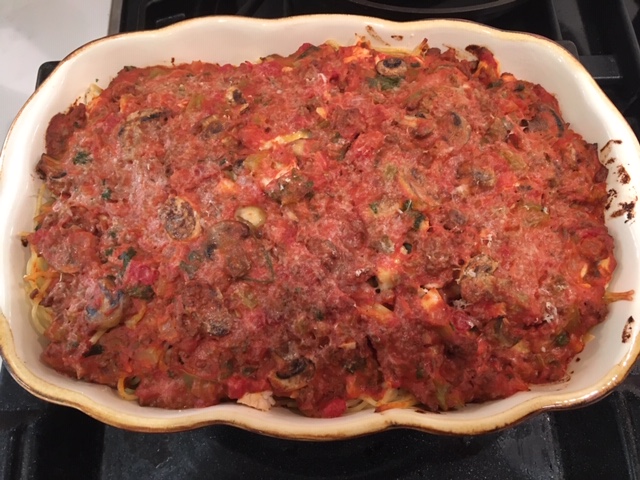
On a recent Saturday, one in which I found myself trapped at home because of smoke-filled skies and hazardous air quality caused by nearby forest fires, I embarked on making Claiborne’s famous chicken spaghetti, a recipe from his own mother’s kitchen that was reportedly celebrated across the Delta. The chicken spaghetti dish is a layered, baked pasta that incorporates two classic sauces, a Ragu and a white sauce along with mushrooms, poached chicken and grated cheddar cheese.
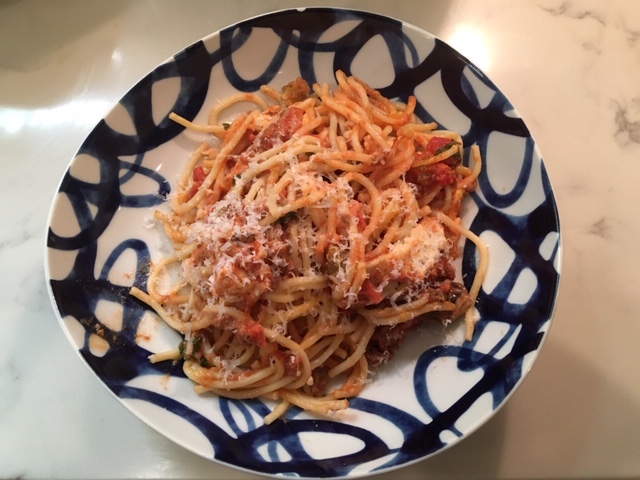
Chicken Spaghetti
I’ve been aware of Claiborne since a young age because my dad’s first cousin is married to his nephew, and because his Mississippi roots were a source of pride to folks in my family, particularly my grandmother, who admired his literary achievement as much as his culinary knowledge. His indispensable “Craig Claiborne’s Kitchen Primer” was the first acquisition of my cookbook library, purchased with my employee discount at B. Dalton Book’s in New Orleans, a few short months after I graduated from college. I still consult that book, 30 years later, to remind myself of many basics, including the section title “How To Make The Best Hamburgers.”
To get a sense of Claiborne the newspaperman, check out the “Craig Claiborne’s Favorites,” a multi-volume collection of New York Times columns from the 1970s. These columns find Claiborne at his most urbane and sophisticated, writing from the perspective of the royal “we” and bringing readers along for his culinary adventures, whether that be preparing delicate meals with his regular co-author Pierre Franey, roaming the ethnic markets of Manhattan’s 9th Avenue or enjoying paella prepared by the former first lady of Panama in her posh Miami home.
The allure of the Chicken Spaghetti is consistent with my affinity for baked pasta dishes. Lasagna was the first multi-step recipe I ever tackled after ordering it at a restaurant as a kid. To her credit, my mom found a recipe, purchased the ingredients and turned the kitchen over to me. Who knows if that first lasagna was any good, but I was hooked on cooking, on the process of chopping, mixing, stirring, simmering, sauteing, assembling, baking, roasting, etc. To me, it’s magic!
Many families have signature spaghetti recipes. My wife’s grandmother was famous for her Dot’s Baked Spaghetti dinners. My great aunt, also from the Mississippi Delta, served her own version of Chicken Spaghetti that involves spreading cooked spaghetti over a mixture of cooked chicken and vegetables and warm stock and letting it sit for half an hour (see “Bayou Cuisine, Its Tradition and Transition,” pg. 211, published by St. Stephen’s Episcopal Church in Indianola, Miss.), and my paternal grandmother’s family members celebrate their unique Garrard Spaghetti, also a layered, baked spaghetti with tomato-based meat sauce and cheddar cheese. Finally, my good friend John Lazzara taught me yet another iconic spaghetti recipe called Johnny Marzetti; his version combines ground chicken, pork and beef with cheese, button mushrooms and black olives. I have great taste memories of each of these proprietary pastas!
Claiborne’s Chicken Spaghetti recipe can be found here, https://www.food.com/recipe/craig-claibornes-chicken-spaghetti-388233
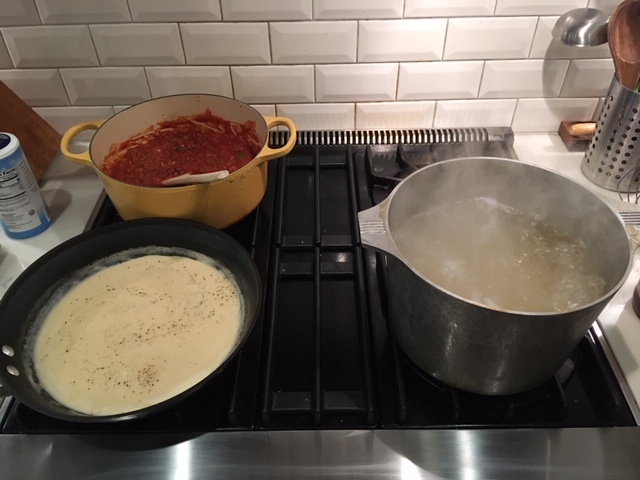
Heeding a tip from the maestro’s nephew, I took a few shortcuts. “Simplify, simplify, simplify,” he told me. Accordingly, I used pre-cooked, pulled chicken, pre-chopped vegetables and high-end, pre-made chicken stock for the white sauce. I also failed to heed the admonition to let the assembled dish sit for four hours before baking.
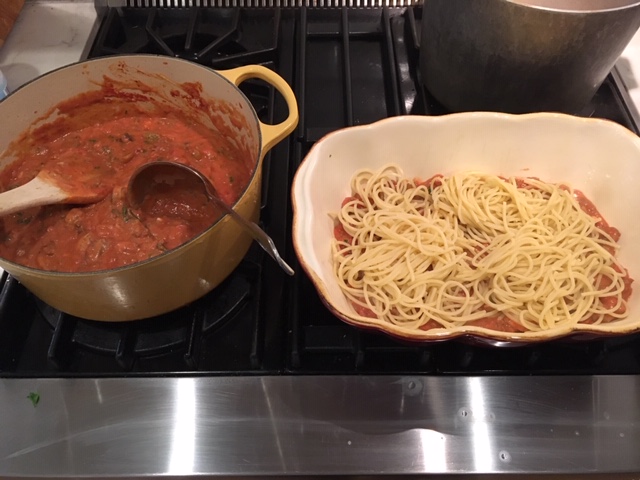
Even removing those steps, the recipe still involves a good bit of work, making the multiple sauces, combining them, layering the sauce, chicken and cooked spaghetti and then baking the whole thing. The result is worth the effort, a surprisingly light pasta dish, given the rich ingredients. Plus, it saved well, and tasted better the next day, probably because it finally got that recommended resting time.
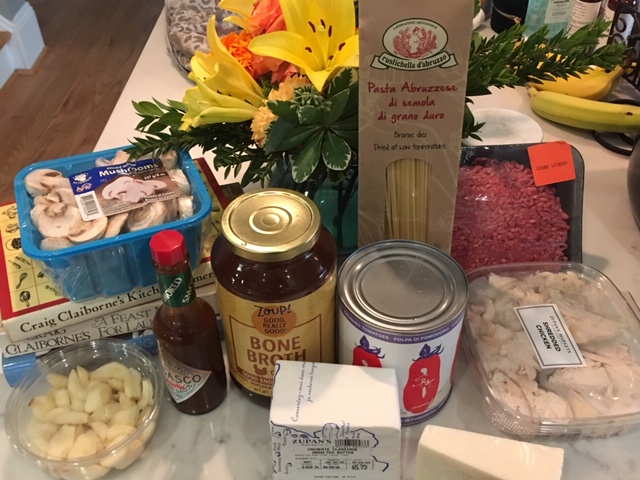
Claiborne’s life and work are a source of great fascination for me, one that I hope may blossom into something more elaborate than this blog post, maybe a longer article or even a book. Until then I have my “Kitchen Primer” and, when I am so inclined, his mother’s Chicken Spaghetti recipe.
This week’s donations of $25 each are going to the Oregon Food Bank and the Lee Initiative. Thank you for spending a little time with me.
 The Nervous Southerner